Dormer Loft Conversion London: Types, Costs & Planning Guide (2026)
Quick Answer
A dormer loft conversion adds a box-shaped structural extension to a sloping roof, creating vertical walls and a flat or low-pitch ceiling. In London, dormer loft conversions cost between £52,000 and £97,500 depending on type and size. Most rear dormers qualify for permitted development rights — meaning no planning permission required. The project typically takes 10–14 weeks from start to finish.
What Is a Dormer Loft Conversion?
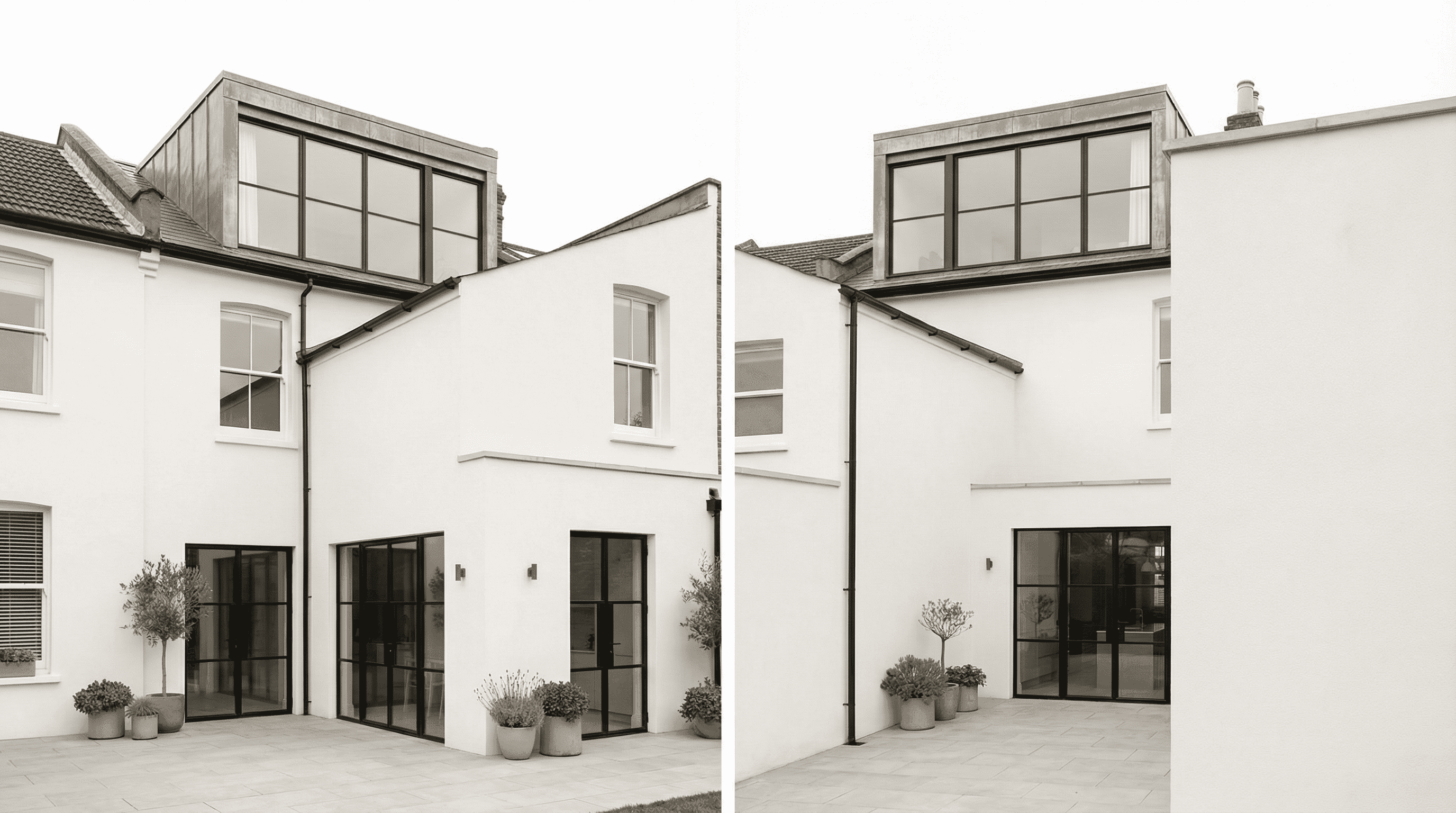
A dormer loft conversion is a structural extension projecting vertically from a sloping roof, creating additional headroom and usable floor space within the roof void. The dormer structure contains vertical walls, a window (or windows), and its own small roof section — either flat, pitched, or hipped.
Unlike a simple Velux (rooflight) conversion, which only adds windows within the existing roofline, a dormer physically extends the roof structure outward. This makes dormer conversions the most popular loft conversion type in London, accounting for approximately 65% of all loft conversions completed in the capital (RICS Residential Market Survey, 2025).
"In London's terraced and semi-detached Victorian and Edwardian housing stock, a rear dormer is almost always the right answer. The geometry of these roofs means you gain a full-height room rather than a cramped space with steeply sloping ceilings." — Vincenzo Puglia, Founder & Lead Architect, HouseUP London
Types of Dormer Loft Conversion
Not all dormers are created equal. The right type depends on your roof structure, planning constraints, and budget.
| Type | Description | Best For | Avg. London Cost (2026) | Planning Required? |
|---|---|---|---|---|
| Rear Dormer | Full-width box extending across rear roof slope | Victorian/Edwardian terraces and semis | £52,000–£78,000 | Usually PD (no permission needed) |
| L-Shaped Dormer | Rear dormer combined with a side return dormer | End-of-terrace and detached houses | £65,000–£97,500 | Usually PD |
| Shed Dormer | Angled dormer with single slope roof | Maximising space on a budget | £49,500–£71,500 | Usually PD |
| Eyebrow Dormer | Low, curved dormer set into the roof | Conservation areas, listed buildings | £32,500–£58,500 | Often requires permission |
| Hip-to-Gable with Dormer | Converts hip roof end to gable + rear dormer | Semi-detached houses with hipped roofs | £71,500–£110,500 | Usually PD for semis |
PD = Permitted Development (no planning application required). Costs include design, structural engineering, construction, and standard finishes. Does not include internal fit-out beyond basic plastering and decoration.
Dormer Loft Conversion Costs in London (2026)
London construction costs are typically 15–25% higher than the UK national average, reflecting higher labour costs, material delivery constraints, and the complexity of working in dense urban environments.
Cost Breakdown by Type
Rear Dormer Loft Conversion — £52,000 to £78,000
The most common type in London. Cost breakdown for a typical 3-bedroom Victorian terrace:
| Item | Cost Range |
|---|---|
| Structural engineering & design | £3,250–£5,200 |
| Planning/building regs application | £650–£1,550 |
| Structural steelwork | £3,900–£7,800 |
| Dormer frame and roofing | £10,400–£18,200 |
| Flat roof covering (EPDM/GRP) | £3,250–£5,850 |
| Dormer windows (UPVC/timber) | £2,600–£6,500 |
| Velux windows (if required) | £1,950–£3,900 |
| Insulation and boarding | £3,900–£6,500 |
| Staircase | £4,550–£9,100 |
| Plasterboard and plaster | £3,250–£5,200 |
| Electrics (lighting, sockets, smoke alarms) | £2,600–£4,550 |
| Decoration and floor finish | £2,600–£5,200 |
| Total (typical) | £52,000–£78,000 |
L-Shaped Dormer — £65,000 to £97,500
The L-shaped dormer is increasingly popular in London because it creates significantly more usable floor space — often adding a full bedroom plus an en-suite. The additional cost reflects the greater structural complexity and roofing area.
Hip-to-Gable with Rear Dormer — £71,500 to £110,500
Common for semi-detached houses in areas like Wimbledon, Chiswick, Ealing, and Richmond. Converting the hipped end to a gable wall adds a full wall of headroom and, combined with a rear dormer, can create a master bedroom suite of 35–45m².
What Affects the Final Cost?
According to HouseUP's analysis of 47 dormer loft conversion projects completed in London between 2023 and 2025, the five biggest cost variables are:
- Existing roof structure — Traditional cut-roof timbers are easier to work with than modern trussed rafters, which require engineered structural solutions
- Access for materials — Properties on terraced streets in inner London (Zone 1–2) typically add £3,900–£7,800 to programme costs due to skip permits, scaffold licensing, and restricted delivery windows
- Dormer window specification — Sliding sash timber windows in a conservation area cost 2–3x more than standard UPVC
- Party wall requirements — On a terrace, both neighbours must be served notice; if they appoint a surveyor, add £1,950–£3,900 per neighbour
- Internal layout complexity — Adding an en-suite bathroom adds £10,400–£19,500 depending on specification
Planning Permission for Dormer Loft Conversions
Permitted Development (No Planning Permission Needed)
Most rear and L-shaped dormer conversions in London fall under Permitted Development Rights (PDR), which means you can build without submitting a planning application — saving 8–12 weeks and approximately £1,950–£3,250 in fees.
Under the General Permitted Development Order (GPDO) Class B, a dormer loft conversion qualifies as permitted development if it meets all of the following:
- Volume — The dormer does not exceed 40m³ for a terrace house or 50m³ for a detached or semi-detached house
- Height — The dormer does not protrude beyond the highest part of the existing roof ridge
- Rear-only — The dormer faces a rear garden, not a highway or principal elevation
- Materials — The dormer cladding is similar in appearance to existing materials (often zinc, render, or matching tiles)
- No balcony — The dormer does not include a balcony, veranda, or platform
- Setback — The dormer sits at least 20cm back from the eaves line
Important: Permitted Development Rights are removed in Article 4 Direction areas, which include many conservation areas across London. Always verify with your local planning authority before starting work.
When Planning Permission Is Required
Planning permission is needed if:
- Your property is in a conservation area (common in Chelsea, Hampstead, Islington, Westminster, Kensington)
- Your property is listed (Grade I, Grade II*, or Grade II)
- The volume limit is exceeded
- The dormer would be visible from a public highway
- Your local authority has issued an Article 4 Direction removing PD rights
- The property is a flat (loft conversions in flats always require planning permission from the freeholder and often the local authority)
In our experience across London, approximately 30% of dormer projects in Zone 1–2 require planning permission, compared to around 12% in Zone 3–5. Conservation area coverage in inner London is extensive — Chelsea alone has 25 designated conservation areas.
Is Your Loft Suitable for a Dormer Conversion?
How to Check
Before instructing an architect, you can do a basic suitability check in 5 minutes:
- Measure the head height at the highest point of your loft (ideally at the ridge). You need at least 2.2m for a viable conversion — the absolute minimum is around 1.9m, but anything below 2.2m will feel constrained.
- Check the roof pitch — Steeper pitches (40°+) give more headroom and volume for a dormer. Shallower pitches (under 25°) are harder to work with.
- Identify the roof structure — Open the loft hatch and check if you have a) traditional cut-rafter timbers (good — can be modified), or b) W-shaped trussed rafters (more expensive to convert, requires structural engineer redesign).
- Check the party wall situation — If you share a wall with a neighbour on either side, you will need to serve a Party Wall Notice before starting work.
- Confirm your property type — Terraced, semi-detached, and detached houses all qualify. Flats require freeholder consent and often a Deed of Variation to the lease.
As a general guide, approximately 75% of traditional Victorian and Edwardian terraced houses in London are suitable for a rear dormer conversion without significant structural complications.
The Dormer Loft Conversion Process: Step by Step
| Step | Description | Timeline |
|---|---|---|
| 1. Feasibility & brief | Architect visits, assesses suitability, confirms volumes and permitted development | Week 1–2 |
| 2. Design & drawings | Full architectural drawings, structural calculations | Weeks 3–6 |
| 3. Party wall notices | Serve notices on adjoining owners (2 months' statutory notice period) | Weeks 3–10 (runs concurrently) |
| 4. Building regulations | Submit drawings to building control; approval in 5–8 weeks | Weeks 5–12 (concurrent) |
| 5. Scaffold erection | Access scaffolding installed, typically 2–3 days | Week 10 |
| 6. Structural works | Steelwork installed, existing timbers modified | Weeks 10–11 |
| 7. Dormer frame & roof | Timber frame built, flat roof laid, flashing installed | Weeks 11–13 |
| 8. Windows installed | Dormer and Velux windows fitted | Week 13 |
| 9. First fix | Electrics, plumbing roughed in; insulation and boarding | Weeks 13–15 |
| 10. Plastering | Walls and ceilings plastered, left to dry | Weeks 15–16 |
| 11. Second fix & decoration | Joinery, electrics, decoration, floor finish | Weeks 16–18 |
| 12. Scaffold down & snagging | Final inspections, building control sign-off | Week 18–19 |
Total programme: approximately 14–18 weeks from appointment of architect to handover. The party wall process often governs the overall timeline — if neighbours are unresponsive or appoint their own surveyor, this can add 4–8 weeks.
Dormer Loft Conversion: London Boroughs Guide
Planning conditions vary significantly across London boroughs. Key considerations:
- Westminster, Kensington & Chelsea, Camden — High proportion of conservation areas; permitted development rights frequently restricted. Expect planning applications in most cases.
- Islington, Hackney, Haringey — Mixed; many conservation areas in older housing stock, but large areas of unrestricted PD. Always check your specific address.
- Wandsworth, Merton, Richmond — Generally more permissive, with fewer article 4 directions. Most rear dormers proceed as PD.
- Chiswick (Hounslow), Ealing, Hammersmith & Fulham — Moderate restriction. Victorian stock suits rear dormers well; consult on conservation area status.
How Much Value Does a Dormer Loft Conversion Add?
According to Nationwide Building Society's property research (2025), a well-executed loft conversion adds an average of 20–25% to a property's value in London. For a property worth £800,000 — typical in many inner London boroughs — that represents £160,000–£200,000 in added value.
The return on investment (ROI) for a dormer loft conversion in London is typically 2:1 to 3:1, meaning for every £1 spent on conversion, the property value increases by £2–£3.
L-shaped dormers on corner and end-of-terrace properties consistently achieve the highest ROI, largely because they add the most usable space (typically 30–45m²) for a proportionately lower cost per square metre.
Frequently Asked Questions
How long does a dormer loft conversion take in London? A rear dormer loft conversion in London typically takes 14–18 weeks from architect appointment to completion. The main variable is the party wall process — if neighbouring owners appoint a surveyor, this can add 4–8 weeks to the programme. The physical construction phase (once approvals are in place) is usually 8–10 weeks.
Does a dormer loft conversion need planning permission in London? Most rear dormer conversions in London qualify as permitted development and do not require a planning application. However, planning permission is required if the property is in a conservation area, is a listed building, or if the local authority has an Article 4 Direction removing permitted development rights. Approximately 30% of dormer projects in inner London (Zone 1–2) require planning permission.
How much does a rear dormer loft conversion cost in London? A rear dormer loft conversion in London costs between £52,000 and £78,000 in 2026, including design, structural engineering, construction, and standard finishes. An L-shaped dormer costs £65,000–£97,500. These figures are 15–25% higher than the UK national average, reflecting London labour rates and material delivery constraints.
What is the difference between a dormer and a Velux loft conversion? A Velux (rooflight) conversion installs windows within the existing roof slope without changing the structure — the cheapest option (£26,000–£45,500) but limited by the existing headroom. A dormer conversion extends the roof structure outward to create vertical walls and a ceiling, giving far more usable space and headroom. Most London homeowners choose a dormer for this reason.
Can I build a dormer on a terraced house in London? Yes. Rear dormer conversions are extremely common on London terraced houses. As long as the property has a sloping rear roof and meets permitted development criteria (principally the 40m³ volume limit), planning permission is not usually required. Party wall notices must be served on both adjoining neighbours.
What is an L-shaped dormer loft conversion? An L-shaped dormer combines a full-width rear dormer with a smaller dormer over the rear outrigger (back addition) of the house — common in Victorian and Edwardian terraced properties. The L-shape creates significantly more usable floor area (often 35–50m²) than a standard rear dormer and can accommodate two rooms plus a bathroom. Cost in London: £65,000–£97,500.
Do I need a party wall agreement for a dormer loft conversion? If your dormer loft conversion involves work on or adjacent to a shared wall with a neighbouring property — which is almost always the case in London terraced houses — you must serve a Party Wall Notice under the Party Wall etc. Act 1996. This is a legal requirement, not optional. The notice period is 2 months, which runs concurrently with your design and planning phase.
How much headroom do I need for a dormer loft conversion? You need a minimum of 2.2m head height at the highest point of your loft (measured from joist to ridge) to achieve a viable living space after conversion. The ideal is 2.4m or more. Properties with less than 2.0m headroom are generally unsuitable without significant structural intervention.
Why Choose HouseUP for Your Dormer Loft Conversion?
HouseUP is a London-based design and build contractor specialising in residential loft conversions, house extensions, and whole-house renovations. We operate across all London boroughs from our offices in Central and West London.
Our dormer loft conversion service covers everything from initial feasibility through to final handover: architectural design, structural engineering, planning and building regulations, party wall management, construction, and interior fit-out. You deal with one team throughout.


Vinz is the CEO and co-founder of houseUP. He is a true authority in financial planning and risk management, coming from years of working in financial services and digital payment industries
houseUP is a construction company in London, specialised in high end residential and commercial projects.