Single Storey Extension London: Costs, Rules & Design Guide (2026)
Quick Answer
A single storey extension in London costs between £45,500 and £110,500 depending on size, specification, and location. Rear single storey extensions up to 4 metres deep (terraced/semi-detached) or 8 metres deep (detached) qualify as permitted development — no planning permission needed. The project takes 12–16 weeks from design to completion. A well-executed single storey extension typically adds 10–15% to a property's market value in London.
What Is a Single Storey Extension?
A single storey extension is a ground-floor addition to an existing house that adds new rooms or extends the footprint on a single level. It is the most common type of home extension in the UK, chosen by homeowners who want to expand living space — typically a kitchen-dining area, living room, or utility room — without the cost or complexity of building upward.
In London, single storey extensions are predominantly built at the rear of the house, often replacing an outrigger (back addition) or extending into garden space. They account for approximately 55% of all home extension projects in the capital (Planning Portal statistics, 2025).
"A well-designed single storey rear extension transforms the ground floor of a London terraced house. Opening up the kitchen into a full-width kitchen-dining-living space is consistently one of the highest-value interventions we make — both in terms of how the family uses the house and in terms of property value." — Vincenzo Puglia, Founder & Lead Architect, HouseUP London
Types of Single Storey Extension
| Type | Description | Best For | Typical London Cost (2026) |
|---|---|---|---|
| Rear extension | Extends backwards into garden | Most terraced and semi-detached homes | £45,500–£84,500 |
| Side return extension | Fills the narrow alley beside Victorian/Edwardian outrigger | Victorian and Edwardian terraces with side passage | £39,000–£71,500 |
| Side extension | Extends to side of property | Detached and some semi-detached homes | £52,000–£91,000 |
| Wrap-around extension | Combines rear and side return into L-shape | End-of-terrace and semi-detached homes | £71,500–£117,000 |
| Infill extension | Fills a courtyard or awkward corner | Unusual plot configurations | £52,000–£97,500 |
Costs include design, structural engineering, foundations, construction to a good specification, and standard finishes (plastered walls, basic floor finish). They do not include kitchen installation, specialist glazing, or high-end finishes.
Single Storey Extension Costs in London (2026)
Cost Per Square Metre
| Specification Level | Cost per m² (London) | What It Includes |
|---|---|---|
| Basic | £2,340–£2,860/m² | Standard brick/block construction, flat or pitched roof, UPVC windows, basic finishes |
| Mid-range | £2,860–£3,640/m² | Better specification materials, timber windows, some glazing elements, underfloor heating |
| High-end | £3,640–£5,200+/m² | Structural glazing, bifold/slide-and-turn doors, polished concrete or hardwood floors, premium kitchen integration |
For comparison, the UK national average for a mid-range single storey extension is approximately £1,600–£2,200/m² — London adds a 20–30% premium due to labour costs, scaffold and skip licensing, and restricted site access in terraced streets.
Full Cost by Common Extension Size
| Extension Size | Basic Spec | Mid-range | High-end |
|---|---|---|---|
| 3m × 4m (12m²) | £28,600–£33,800 | £33,800–£44,200 | £44,200–£62,400 |
| 4m × 4m (16m²) | £37,700–£45,500 | £45,500–£58,500 | £58,500–£83,200 |
| 4m × 5m (20m²) | £46,800–£57,200 | £57,200–£72,800 | £72,800–£104,000 |
| 4m × 6m (24m²) | £55,900–£68,900 | £68,900–£87,100 | £87,100–£124,800 |
| Full-width rear (30–35m²) | £70,200–£91,000 | £85,800–£109,200 | £109,200–£156,000 |
Key Cost Factors
Based on HouseUP's completed extension projects across London (2023–2025), the five factors that most affect final cost are:
- Glazing specification — A standard rear wall with French doors costs roughly £5,200–£7,800. Full-width bifold or slide-and-turn doors add £10,400–£23,400. Rooflights add £1,950–£5,200 each.
- Foundation type — Standard strip foundations (£3,900–£6,500) suit most London sites. Clay-heavy ground or proximity to trees may require deeper foundations or piles (add £6,500–£19,500).
- Roof specification — A simple flat roof (EPDM or GRP) costs £4,550–£8,450 for a typical extension. A glazed roof lantern adds £7,800–£15,600. A pitched tiled roof adds 10–15% to the build cost.
- Site access — Properties in inner London with no rear access add £2,600–£6,500 for skip licensing, scaffold permits, and restricted working hours.
- Structural complexity — Removing a load-bearing wall between the existing house and new extension requires a structural steel beam (typically £3,250–£6,500 for beam and installation).
Planning Permission Rules for Single Storey Extensions (London)
Permitted Development: What You Can Build Without Permission
Under the General Permitted Development Order (GPDO), single storey rear extensions are permitted development — no planning application needed — if they meet all conditions:
For terraced and semi-detached houses:
- Maximum depth: 4 metres from the original rear wall
- Maximum height: 4 metres at the ridge; 3 metres at the eaves
- Must not cover more than half the garden
For detached houses:
- Maximum depth: 8 metres from the original rear wall
- Maximum height: same as above
All properties:
- Extension must not be forward of the principal elevation (front of the house)
- Materials should be similar in appearance to the existing house
- No verandas, balconies, or raised platforms
- Side extensions must not exceed half the width of the original house
Neighbour consultation scheme: For rear extensions between 4m and 8m deep on detached houses (or 3m to 4m on terraces/semis), a Prior Approval application to the local council is required. This is a 42-day neighbour consultation, not a full planning application — but it must be completed before work starts.
When Planning Permission Is Required
A full planning application is needed if:
- The property is in a conservation area — extensions visible from a public road require permission
- The property is listed (Grade I, II*, or II) — listed building consent required
- The extension exceeds the permitted development size limits
- The property is a flat — flats cannot use PD rights; all extensions require full planning permission
- The local authority has an Article 4 Direction removing PD rights
In London, approximately 35–40% of single storey extension projects in inner boroughs require a planning application, primarily due to conservation area coverage. In outer London boroughs, this drops to around 15–20%.
Design Ideas for Single Storey Extensions in London
Kitchen-Diner Extensions
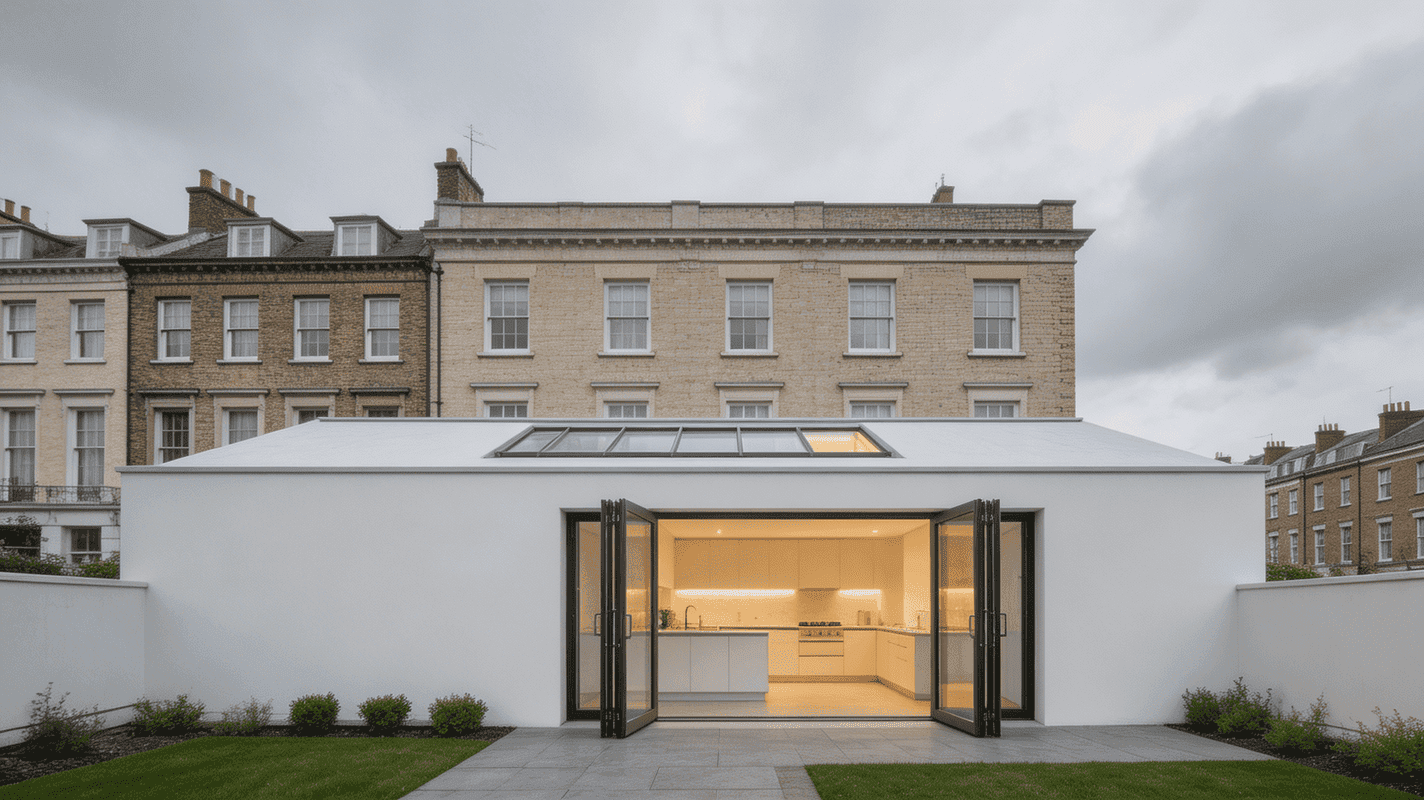
The most popular use of a single storey rear extension in London. A full-width rear extension (typically 4m × 5m to 4m × 6m) creates an open-plan kitchen-dining-family room that opens to the garden via bifold or slide-and-turn doors.
Key design considerations for London terraced houses:
- Natural light — Without side windows, a full-width rear extension can be dark. Rooflights are essential, particularly over the kitchen and dining area.
- Connection to garden — Floor-to-ceiling glazing and level thresholds (extensions designed to the same level as the garden) blur the boundary between inside and outside.
- Structural frame — Removing the original rear wall (load-bearing in most Victorian houses) requires a steel frame. Design this as a feature rather than hiding it.
Open-Plan Living Extensions
Ground-floor living room extensions are increasingly popular in London houses where the original layout divides front reception, rear reception, and kitchen. A single storey extension can extend the rear reception into a larger open living-kitchen space without touching the original building envelope significantly.
Side Return Extensions
Unique to London's Victorian and Edwardian terraced stock, the side return extension fills the narrow gap (typically 1–2m wide) between the house and the boundary wall. Alone, a side return adds modest width; combined with opening up the kitchen-dining area, it can create a genuinely open-plan ground floor from a previously fragmented layout.
Average cost of a side return extension in London: £39,000–£71,500. Total combined with kitchen renovation: typically £65,000–£104,000.
Single Storey Extension vs Loft Conversion: Which Is Right for You?
| Factor | Single Storey Extension | Loft Conversion |
|---|---|---|
| What space it creates | Ground-floor living/kitchen/dining | Bedroom(s) + bathroom |
| Typical cost | £45,500–£110,500 | £52,000–£97,500 (dormer) |
| Garden impact | Reduces garden size | No garden impact |
| Disruption | High — ground floor unusable during build | Medium — can usually live in house |
| Value added | 10–15% (varies with spec) | 15–20% (bedroom adds most value) |
| Planning | Usually PD (some London exceptions) | Usually PD |
| Best for | Improving everyday living, entertaining | Adding bedroom(s) or value before sale |
Many London homeowners do both — a single storey rear extension first, then a loft conversion a few years later. Combining both projects is usually more cost-effective if done simultaneously (shared scaffold, single set of party wall notices, one building control application).
The Single Storey Extension Process: Step by Step
| Step | Description | Typical Timeline |
|---|---|---|
| 1. Initial consultation | Feasibility review, budget discussion, site visit | Week 1–2 |
| 2. Concept design | Floor plans, elevations, material selections | Weeks 2–5 |
| 3. Planning pre-app (if needed) | Informal discussion with council planner | Weeks 4–6 |
| 4. Planning application (if required) | Submitted; 8-week determination period | Weeks 5–13 |
| 5. Party wall notices | Serve notices on adjoining owners | Weeks 4–12 (concurrent) |
| 6. Technical design | Full working drawings, structural calculations | Weeks 5–8 |
| 7. Building regulations | Submit to building control; approval in 4–6 weeks | Weeks 8–14 (concurrent) |
| 8. Contractor procurement | Finalise build contract, agree start date | Weeks 9–12 |
| 9. Groundworks | Excavation, foundations, drainage | Weeks 12–14 |
| 10. Superstructure | Walls, roof structure, weatherproofing | Weeks 14–18 |
| 11. First fix | Electrics, plumbing, underfloor heating | Weeks 18–20 |
| 12. Insulation, boarding, plastering | Internal walls and ceilings | Weeks 20–22 |
| 13. Second fix & finish | Windows, doors, joinery, decoration, floor finish | Weeks 22–24 |
| 14. Snagging & handover | Final inspections, building control completion certificate | Week 24–25 |
Total from design to completion: approximately 20–26 weeks for a project requiring planning permission; 14–18 weeks for a straightforward permitted development project.
Frequently Asked Questions
How much does a single storey extension cost in London in 2026? A single storey rear extension in London costs between £45,500 and £110,500 depending on size and specification. The cost per square metre ranges from £2,340/m² for a basic build to £5,200+/m² for a high-specification glazed extension. London costs are typically 20–30% higher than the UK national average due to labour, site access, and materials logistics.
Do I need planning permission for a single storey extension in London? Most single storey rear extensions in London qualify as permitted development and do not need a planning application — provided the extension is no deeper than 4 metres (for terraced and semi-detached houses) or 8 metres (for detached houses). However, planning permission is required for properties in conservation areas, listed buildings, and where Article 4 Directions apply. Approximately 35–40% of inner London extensions require a planning application.
How long does a single storey extension take to build? A single storey extension in London takes approximately 14–18 weeks to build if it's a permitted development project. If a planning application is required, add 8–10 weeks for the planning process. The full programme from initial design to handover is typically 20–26 weeks for a project requiring planning permission, or 14–18 weeks for a straightforward PD project.
What is the maximum size for a single storey extension without planning permission? Under permitted development rules in England (2026), a rear single storey extension can be up to 4 metres deep for terraced and semi-detached houses, or up to 8 metres deep for detached houses — without requiring a planning application. The maximum eaves height is 3 metres and the maximum ridge height is 4 metres. Extensions within the size range of 4–8m (semi/terrace) or 4–8m (detached) require a Prior Approval notification (neighbour consultation) rather than a full application.
How much value does a single storey extension add in London? A well-executed single storey extension in London adds approximately 10–15% to the property's market value. For a London house worth £700,000, that represents £70,000–£105,000 in added value. A kitchen-diner extension that creates an open-plan living space is consistently the highest-value type, particularly in inner London where buyers place a premium on entertaining space.
Can I build a single storey extension in a conservation area? Yes, but planning permission is usually required. In a conservation area, extensions visible from a public road need a planning application regardless of size. Extensions to the rear that are not visible from a public highway may still qualify as permitted development in some conservation areas — but you must check with your local planning authority first. Materials and design will be scrutinised more closely, often requiring traditional brick or render to match the existing building.
Do I need a party wall agreement for a single storey extension? If the extension involves digging foundations within 3 metres of a neighbouring building, building on or against a shared (party) wall, or excavating within 6 metres of a neighbouring structure, you must serve a Party Wall Notice under the Party Wall etc. Act 1996. For most terraced and semi-detached properties in London, a party wall notice will be required. The statutory notice period is 1–2 months, which should run concurrently with your design and planning phase.
What is a side return extension? A side return extension fills the narrow alley or passage that runs alongside many Victorian and Edwardian terraced houses in London. The side return is typically 1–2 metres wide and runs from the back of the main house to the rear boundary. Converting this space — usually combined with a rear extension and opening up the kitchen wall — creates a much wider open-plan ground floor layout. Cost: £39,000–£71,500 for the extension alone.
Can a single storey extension be combined with a loft conversion? Yes — and combining both in a single project is often more cost-effective. Shared scaffold, a single set of party wall notices, and one building control application reduce the combined cost compared to two separate projects. A typical combined rear extension and dormer loft conversion in London costs £97,500–£169,000 and can add 25–35% to a property's value.
Why Choose HouseUP for Your Single Storey Extension?
HouseUP is a London design and build contractor with extensive experience in single storey extensions, kitchen-diner conversions, and whole-house renovations. We manage every stage — from initial design through to final handover — from our offices in London.
Our approach combines architectural design, structural engineering, planning expertise, and construction management under one roof. We work across all London boroughs and have completed projects in conservation areas, on listed buildings, and in some of London's most complex terraced streets.


Gen is managing director and chief of digital strategy at houseUP. She has a background in information security and product management in tech startups.
houseUP is a construction company in London, specialised in high end residential and commercial projects.